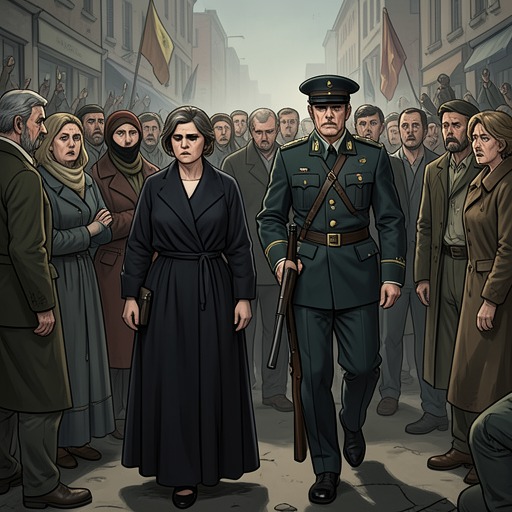
Cumann na mBan
Say NothingCumann na mBan was the women’s auxiliary organization associated with the IRA, but its place in the story is more than a supporting role. Across generations of the Price family, it linked republican commitment to imprisonment and practical work in the conflict. Later, when Dolours Price refused to be confined to an auxiliary position, the organization became the point of contrast against which she demanded equal participation as a combatant.
Identity and Family History
The organization was woven into the Price family’s history before Dolours Price entered the republican movement. Her maternal grandmother, Granny Dolan, had belonged to Cumann na mBan and served three months in Armagh jail after attempting to take a Royal Ulster Constabulary officer’s service weapon. Chrissie Price, Dolours’s mother, had also served in the organization. She and three of her sisters were imprisoned in Armagh after being arrested for wearing Easter Lily emblems: small paper flowers in orange, white, and green that had been banned.
That history made the organization part of a wider inheritance in which republican activity, arrest, and imprisonment were familiar across the family. Cumann na mBan was not simply an abstraction or a distant political body for Dolours: women close to her had belonged to it and had faced punishment for their participation. Its family presence helps explain why entry into republican activity could feel like a continuation of inherited commitments, even as Dolours would contest the role conventionally offered to women within that tradition.
Work and Methods
Cumann na mBan’s auxiliary status did not mean that its work was merely ceremonial. The account describes women caring for injured men and carrying away a gun after a shooting while it was still hot from use. Such tasks connected the organization to the practical demands and risks of armed operations, even when women were not recognized as full members of the IRA. The distinction was therefore between a supporting organizational position and the kinds of work women might actually perform, not between consequential and inconsequential activity.
The book’s broader account also places women in other parts of republican activity, including courier work, while noting that women could be used as romantic lures. These references point to the varied and sometimes instrumental ways the movement involved women. They do not erase the difference between an auxiliary organization and the IRA itself; rather, they show that women’s participation could be operationally important while remaining constrained by gendered expectations. Cumann na mBan’s position makes that tension visible: women could take on dangerous responsibilities without automatically receiving equal standing.
Dolours Price and the Demand for Full Membership
After the Burntollet Bridge ambush changed her view of nonviolent protest, Dolours Price approached Seán Mac Stíofáin about joining the Provisionals. He initially proposed Cumann na mBan, the same organization in which her mother, aunt, and grandmother had served. Women there could tend to wounded men or remove weapons from a scene, but Price took the proposal as a relegation to an auxiliary role. She insisted that she wanted to fight and do the same work as a man, rather than make tea or roll bandages.
Price’s objection challenged the boundary between assistance and combat, and between participation and membership. She wanted recognition as a fighting soldier, not merely a place in the women’s wing. A special meeting of the Provisionals’ Army Council followed, and it decided that women could, for the first time, join the organization as full members. The account presents Price’s ambition and republican family background as likely important to that decision, while also recording her own speculation that the mass imprisonment of men may have made the Provisionals more willing to admit women. The change thus arose both from an individual demand and from pressure on the organization.
Gender, Recognition, and Narrative Significance
Cumann na mBan represents an established route into republican work for women, but the episode of Price’s recruitment exposes the limits of that route. The women’s organization had members who took on serious and risky duties; nevertheless, Price believed that joining it would place her in a subordinate capacity. Her insistence on equal work made formal status itself a stake in the argument. The subsequent decision to admit women as full members altered the organizational boundary, even though the evidence does not establish that this erased gendered divisions throughout the movement.
The book also sets women’s organizational roles beside the ways they were remembered and represented: through revolutionary folklore, gendered reporting, and practices of paramilitary social control such as tarring and feathering. These details widen the context around Cumann na mBan without reducing its members to symbols. The organization stands at the intersection of practical service, inherited republican identity, and a struggle over who could claim the status of an armed participant. Its significance lies both in the work women performed and in the contested boundary that Dolours Price forced the Provisionals to reconsider.